

It’s 2 a.m. when your phone buzzes. Your building’s fire alarm has just been activated. Not exactly how anyone wants to start the day.
Few things are more disruptive for a property or facility manager than late-night alarm notification. Tenants are uneasy, overnight staff are displaced, the fire department is en route, and you’re trying to determine what happened before you’ve even had your first cup of coffee.
Soon you learn there was no fire — just a false alarm. Relief quickly turns to frustration. If there was no smoke or fire, why did the system activate?
False alarms like these are more than an inconvenience; they can interrupt operations, erode tenant confidence, and cost time and money. But they’re rarely random. In most cases, your fire alarm system is signaling an underlying issue.
Here are the most common reasons a building fire alarm might activate unexpectedly in the middle of the night — and what those signals are trying to tell you.
1. System Maintenance Issues
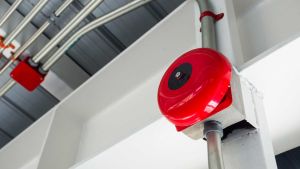
Aging or neglected systems are prone to false alarms. Worn sensors, loose wiring, or outdated equipment can trigger alarms without cause, especially in buildings where inspections or updates have been delayed.
Fire alarms are designed to be sensitive, and as these systems age, an old connection can become faulty and cause the alarm to sound for no reason.
What to do: Make sure your fire alarm system is inspected annually, any necessary repairs are made in a timely fashion, and components get replaced as they age.
2. Dust, Debris, or Insects in Detectors
Commercial detectors are extremely sensitive by design. While false alarms are disruptive and frustrating, the sensitivity of modern fire alarm systems gives building tenants more notice to evacuate in case of fire.
So, if there’s no smoke, what is tripping up these sensors? Dust from renovation projects is a common culprit, as is dirt and debris stirred up from nearby construction. Even insects entering the detector can trip the system. These types of false alarms often happen at night when disturbances in the building go unnoticed until the alarm sounds.
What to do: Routinely clean smoke detectors, making sure to remove any protective covers and clear out accumulated dust or bugs. Ensure any contractors working in the building protect devices during any construction or maintenance projects.
3. HVAC and Environmental Factors
Sudden changes in air pressure, humidity, or temperature caused by HVAC systems can create conditions that mimic smoke. For example, steam from plumbing leaks or drafts near detectors can cause false activations.
As mentioned above, dust is a big trigger for false alarms.
- Airflow movement: When the HVAC system turns on, it pushes air through ducts and vents. If there’s dust buildup in those ducts or around the vents, that dust can be stirred up and carried into the air.
- Settled dust disruption: Dust that’s been sitting undisturbed in ceiling spaces, ducts, or return vents can suddenly get blown around when the system cycles. This can also happen after a duct cleaning, when dirt and debris is stirred up during cleaning.
- Detector sensitivity: Fire alarm smoke detectors, especially optical/photoelectric ones, are designed to sense small particles in the air. Dust particles can look very similar to smoke particles to a detector, causing false alarms.
That’s why property managers and facility managers often see a spike in “mystery” alarms after HVAC maintenance, seasonal system changes (like switching from heat to A/C), or in buildings that haven’t had ductwork cleaned in a while.
What to do: Review detector placement in relation to air vents, kitchens, or mechanical rooms. Mitigate and contain dust as much as possible, especially during renovation projects, construction, or cleaning. Relocating or upgrading detectors can help.
4. Low Batteries or Power Fluctuations
For properties with older or hybrid alarm systems, a power surge, outage, or dying battery backup can lead to an alarm activation. Even if your system is hardwired, faulty connections or failing power supplies can cause problems.
What about if the internet/system goes down? You can rest assured that even if your fire alarm system works with your IT infrastructure for monitoring and management, its core safety functions (detecting smoke/heat and sounding alarms) do not depend on the IT network. These systems are designed to remain functional even if the internet or building network is down.
What to do: Ensure batteries are replaced on schedule and have a qualified technician regularly test backup power systems.
5. Real (But Hidden) Risks
Never assume a false alarm means “nothing happened.” A smoldering wire, an overheated machine, or a brief puff of smoke may have triggered the system. Even if the danger wasn’t immediately obvious, that doesn’t necessarily mean it was a false alarm.
What to do: Always treat alarms seriously and investigate with the help of your fire alarm monitoring service and local fire department…yes, even in the middle of the night.
When To Call A Professional
But by taking the proper preventative measures and being proactive with your alarm system maintenance, you can largely avoid the disruptions of late-night false alarms.
Frequent false alarms are a nuisance for certain, but beyond that, they’re a sign that something isn’t quite right with your system. It’s never safe to get complacent and assume it’s a false alarm, no matter what time it is or how many times it’s been a false alarm in the past.
When a false alarm is a rare event, it’s likely caused by one of the above culprits, but when it happens on a repeated basis, it starts to erode trust in the system from employees, tenants, company leaders, as well as the local fire department. It also leads to uncertainty as to whether the alarm will detect a real emergency.
If you’ve been dealing with frequent false alarms, there’s likely something going on behind the scenes that’s worth getting checked out by a professional.
At Wellington Security Systems, we help property and facility managers prevent these issues with proactive system inspections, monitoring, and maintenance. Whether it’s a late-night false alarm or preparing for your next fire marshal inspection, our team ensures your fire protection systems are reliable, code-compliant, and ready to protect both your property and your tenants.
Need support with your fire alarm systems? Contact us today to schedule a service or inspection.
Wellington Security Systems is a trusted commercial security systems partner serving customers in and around the Twin Cities metro for over 40 years, specializing in burglary systems, access control, surveillance cameras, and fire alarms. For more information or a free security audit for your business, contact us today.